Courageous Chloe fights back after stroke
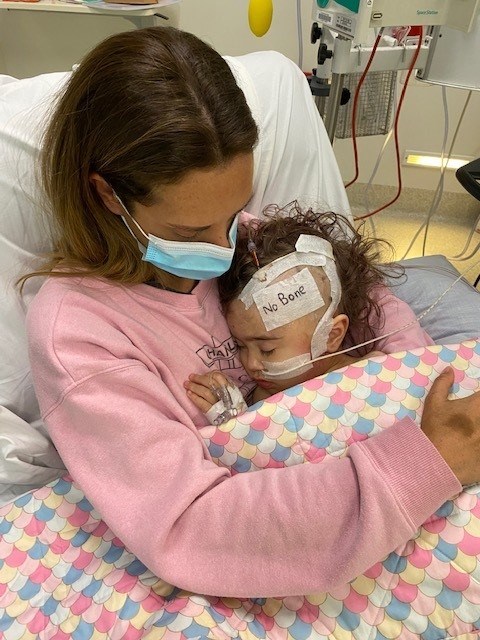
It’s been twelve months since little Chloe Burnett’s life changed forever. The three-and-a-half-year-old has overcome more than any toddler should ever have to, including a four-month stay in hospital, four brain surgeries and multiple strokes.
Her Mum Alicia recalls the day in June 2022 their journey first began.
“My partner went to get Chloe up for the day and noticed something wasn’t right. She couldn’t stand up, her mouth had dropped to one side, and she couldn’t lift her arms,” she said.
Alicia had completed a first aid course and recognised Chloe was experiencing the telltale F.A.S.T. signs of stroke. She was rushed to Queensland Children’s Hospital for an emergency MRI.
“Halfway through the MRI, we were pulled into a private room for a chat with doctors who told us Chloe had a large brain tumor. It’s a moment I’ll never forget. It was heartbreaking, we were shocked, confused and overwhelmed with sadness for our little girl,” she said.
“We were told the brain tumor was too big to completely remove and the only option was chemotherapy and debulking brain surgery. While waiting for the surgery we found out Chloe had experienced multiple strokes.”
What followed was a long journey in hospital, including a stay in the paediatric intensive care unit after Chloe had brain surgery to remove a large section of her skull to reduce the swelling on her brain.
“We were told on multiple occasions to prepare for the worst, that Chloe may not make it through the night. Thankfully she did survive. After the strokes, she had to learn to swallow food and fluids, talk, roll and sit up all over again,” Alicia said.
Chloe is now back home and receiving care from an allied health team who specialize in childhood stroke.
“We’re hoping she will go off to Kindy next year which will really help her, she’s such a social butterfly. We’re also getting her a walker, which should help with her mobility.”
Approximately 600 Australian children have a stroke each year. To mark National Stroke Week (August 7-13), Stroke Foundation is encouraging the community to fight stroke together by bringing people together to share knowledge, support and resources to help prevent strokes from occurring and to aid in the recovery process for those who have experienced a stroke.
Stroke Foundation Chief Executive Officer Dr Lisa Murphy said it’s a common misconception that stroke only happens to the elderly.
“Stroke can happen to anyone, at any time. Even newborn babies have strokes. Around a third of all strokes in children occur under one year of age,” Dr Murphy said.
“We know the faster an adult or child with stroke gets to hospital and receives medical treatment, the better their chance of survival and a good recovery. Learning the F.A.S.T. acronym can make a real difference.”
Think F.A.S.T and ask these questions:
Face – Check their face. Has their mouth drooped?
Arms – Can they lift both arms?
Speech – Is their speech slurred? Do they understand you?
Time – Time is critical. If you see any of these signs, call 000 straight away.
National Stroke Week is proudly supported by Major Sponsors: EMVision, AbbVie, and AstraZeneca, and Supporting Sponsors: Precision Group and Rossmax Australia.
