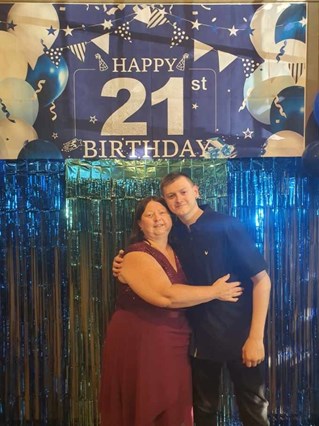
Mildura family struck twice by stroke
It was an ordinary day at school for 16-year-old Jordan Macdonald when stroke first changed his family’s life.
The year 10 student was on recess when his friends noticed he couldn’t raise him arm properly. He was rushed to sick bay, where his mum, Janine Shaw, who worked at the school called an ambulance.
At hospital, doctors discovered Jordan had a hole in his heart which caused the stroke. Now 21, Jordan has since made a full recovery.
Janine did everything she could to focus on Jordan’s recovery and spent many hours researching strokes, never thinking she would have one just five years later.
In February this year, Janine began feeling unwell after spending the day shopping.
“Jordan came out of his room and said I didn’t realise you were home, I went to respond but I couldn’t speak. It was terrifying for him to see me like that,” Janine said.
“He went and got my husband, and they called an ambulance. I have no doubt their quick-thinking saved my life that day.”
At hospital, Janine was told she too had a hole in her heart. She has since undergone surgery to have the hole repaired with hopes it will prevent further strokes in the future.
“My recovery is ongoing. I still have weakness on my left side and lost all hearing in my left ear. I will probably be on medication for the rest of my life, but I am thankful to still be here today,” she said.
“I want people to be aware that stroke can happen to anyone at any time. I was only 45 and Jordan was only 16. The best thing you can do is call an ambulance as quickly as possible.”
Janine and Jordan are sharing their story to mark National Stroke Week which runs from August 5 to 11 and encourages people to know the F.A.S.T. (Face, Arms, Speech and Time) message to ensure they can save the life of a loved one if they have a stroke.
Stroke Foundation Chief Executive Officer Dr Lisa Murphy said regional Australians are 17% more likely to experience a stroke than their metropolitan counterparts.
“Jordan and Janine’s story highlights the fact that stroke can happen to anyone, at any age, at any time. Unfortunately, stroke does not discriminate,” Dr Murphy said.
“We know that the faster a stroke patient gets to hospital and receives medical treatment, the better their chance of survival and successful rehabilitation. You can help saving a life by learning the F.A.S.T. signs of stroke.”
Think F.A.S.T and ask these questions:
Face – Check their face. Has their mouth drooped?
Arms – Can they lift both arms?
Speech – Is their speech slurred? Do they understand you?
Time – Time is critical. If you see any of these signs, call 000 straight away.
More information about stroke prevention and awareness can be found at the website.
National Stroke Week is proudly supported by major sponsor: EMVision and supporting sponsors: AbbVie and Precision Fundraising.