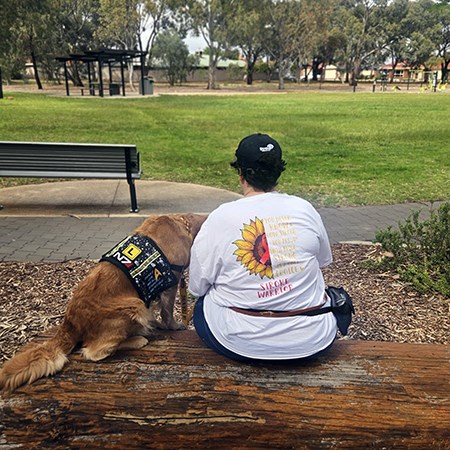
I was 31 when I had my strokes
By Bronwen
I was 31 when I had my strokes.
My first stroke was almost like a TIA, but it wasn’t recognised as a stroke until after my second one. It was caused by a dissection of my M1 artery, which threw several small blood clots. After a number of visits to the ED, I was finally called back to the stroke unit at the RAH and sent home with strict instructions: if any symptoms returned, I was to get straight to the ED.
The second stroke was different. The symptoms weren’t recognised at first, not even by the paramedics, only my mum knew what was happening. That morning I’d felt dizzy and lightheaded and called her to say I couldn’t make it to our appointment. She came over straight away.
By then, I was wobbling all over the place, struggling to pull up my pants, my left hand wasn’t working, and my speech was slow and slurred. Mum called 000, but the paramedics said I wasn’t having a stroke because I was responsive and could still talk. Mum tried to explain my history and that this wasn’t normal for me, but it wasn’t taken seriously.
I was taken to hospital but left ramped for a while. In the ED I fell in the bathroom and from there things just got worse. The next day, in front of my mum and mother-in-law, I lost almost all movement in my body – except for my shoulder. Thankfully, a wonderful doctor intervened, liaised with the neurologists from RAH, and pushed for me to go to ICU. I spent 72 hours there and received 10 units of blood.
I later learned that this was a type of ‘demand ischemia’. I have severe narrowing in the M1 artery, and when I had catastrophic blood loss, my blood pressure dropped so low that oxygen couldn’t reach my brain. That’s what caused the stroke.
When I was told the words, “Yes, it was a stroke,” I felt helpless. My world imploded. I couldn’t stop worrying about what my future would look like. I was devastated that I would miss competing at the Royal Adelaide Show with my dog. I feared for my job prospects. I thought of my dad’s stroke, and how much it had affected him, and I was terrified I’d end up the same.
I’ve been left with ongoing challenges. My left hand feels numb, and I can’t always tell what I’m holding unless I look. I used to type quickly and accurately, but now it’s slow and difficult. Playing the piano is a struggle. Out in public, I find crowds, lights, and sounds overwhelming, so I rely on sunglasses and Loops to cope.
I also have memory issues and need someone with me at appointments. Time awareness, planning, and even calculating time between events can be really hard. I’ve had vision problems, but I’m working with a behavioural optometrist to retrain my sight.
Emotionally, I feel raw. I cry at the smallest things and often describe myself as “discombobulated.” Social fatigue hits me hard, and I need support from my partner or mum whenever I go out.
Despite all this, I try to focus on the small wins. I actually began Stride4Stroke while I was still in hospital – logging my rehab sessions as exercise minutes. It gave me a sense of accomplishment and helped me feel like I was still working towards something, especially since it coincided with the 15-year anniversary of my dad’s stroke.
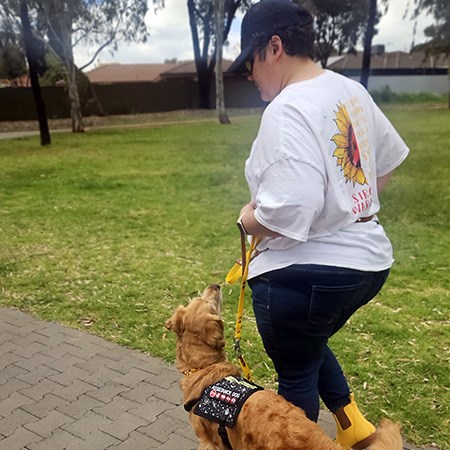
My dad was my inspiration. He survived a catastrophic haemorrhagic stroke when I was 16. Doctors thought he’d end up in a nursing home, but he fought back and eventually returned home and to work to provide for us kids. His determination taught me never to give up.
In ICU, I would play little games with my teddy bear, like touching my nose or moving each finger to my thumb. I knew my dad had never regained movement in his left hand, and I didn’t want the same outcome. My mum kept encouraging me: “Small moves, Bronnie.” (a line from one of our favourite movies, Contact). Later, on the stroke ward, I’d practise picking up my Dungeons & Dragons dice – different shapes and sizes that forced me to challenge my coordination.
It may sound cliché, but a positive attitude has been vital. I’ve held onto the goals I love most: competing in agility with my dogs, running again, and simply living life as fully as I can.
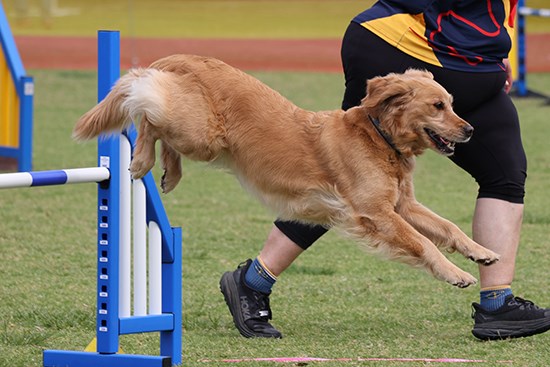
I owe everything to my family and partner, who have been my rock, and to the people who donate blood – without them, I wouldn’t be here today. Even though I can’t donate blood myself anymore, I’ll always be grateful.
I also want to thank the doctors, nurses, and incredible staff at the Lyell McEwin Hospital stroke unit and ICU, as well as my rehab team at Modbury Hospital. They carried me through the darkest days.
I’m still in rehab, still working on higher-order cognitive issues, and still learning to navigate the world again. But I’m proud that I’m home, I’m standing, and I haven’t lost my sense of humour.
And yes – I’m especially proud of my dogs for being such good girls.