My first word was thank you
By Jennifer Phelan
I’ve lived with heart concerns from a young age and ultimately, they led me to suffer a catastrophic stroke that nearly killed me at the age of 38.
I had the atria septal defect I’d been born with repaired in 1987 when I was four years old, which kick-started annual cardiologist visits and echocardiograms for monitoring purposes.
I thought I was fixed. I even joined the army in 2001, where I remained until I was medically discharged due to an ankle injury three years later.
At one of my annual echocardiograms, it was noticed I had an enlarged artium. I didn’t think too much of this; I didn’t have any symptoms, was relatively fit, and just figured it was something additional to keep an eye on.
In 2020, my husband and I were living in Melbourne with our two boys, who were three and one at the time.
We were both working as sports journalists, covering mainly AFL.
Of course, the world got shut down all of a sudden, which coincided with a deterioration in my health.
With the boys’ daycare only open to the children of essential workers, suddenly we were all home together, every day.
This was also the time my enlarged artium decided to throw me a curveball and plunge me into uncontrollable atrial fibrillation (AF) that sent my heart rate skyrocketing.
The first time it happened, I panicked and called my cardiologist, who assured me that while it was uncomfortable, it wasn’t dangerous.
He sent me a script for a stronger blood thinner and told me to come in for a cardioversion, where the cardiologist administers a small electrical shock under sedation to get a heart back into normal rhythm.
It would be the first of many for me, unfortunately.
I then had a cardiac ablation, which is a surgical procedure that fixes faulty electrical wiring in the heart by creating tiny scars inside the heart’s walls that are supposed to stop the bad signals causing an abnormal heartbeat.
It worked for a few months, but the AF came back to my dismay. Still, I was living as normally as you can during a pandemic while contending with two kids under three, all the while struggling against AF that kept reoccurring.
Months of shutdowns in Melbourne were tough going mentally, especially as I dealt with a health issue that required me to visit hospitals and doctors regularly, and we decided to move to Adelaide when the borders opened.
My AF remained unresolved, and while it could sometimes be controlled with medication, other times I needed a cardioversion to “reset”. It was hard never quite knowing when it was going to rear its head.
It was decided I’d have a second ablation, which also didn’t work. I was now getting cardioverted on an average of every fortnight, but even they’d only provide limited relief.
The third ablation was where disaster struck.
It was a longer than expected procedure, I was ‘under’ for about six hours, and the first the doctors knew something was wrong was when I didn’t wake up from the anaesthetic.
After a period of time a ‘Code Stroke’ was called and I had emergency surgery that evening to remove blood clots in both sides of my brain and repair a ruptured carotid artery.
I had suffered an extensive bleed on my brain – Jason would later overhear a doctor refer to my scans as “horrendous” – and I was moved to ICU.
Initially, Jase was told it was unclear if I would pull through.
Over the next day or so I stabilised to the point where I was going to live, but the neurologists painted a pretty bleak picture of what sort of life I might have.
I was intubated in ICU for a week; apparently I was awake in brief patches, and I remember my neurologist doing the test where he pretended to slap me to see if I had a natural flinch reaction, but I was completely unresponsive.
Jase brought my phone in and played music quietly next to my bed. I remember one time after he’d gone home one album was left on repeat for hours, but I couldn’t ask the nurses to change it. It used to be one of my favourite albums, but I can’t listen to it anymore!
It was strange - I was aware of my surroundings off and on, but had no idea what had happened.
I remember some of the doctors and nurses from that time. Years later, while in the waiting room to see my neurologist, I recognised one of his colleagues who had consulted on my case in the ICU.
They’re good people who do an amazing job.
The COVID border closures for interstate visitors were still in place, so my Dad, step-mother and brother couldn’t come from Melbourne because I “wasn’t sick enough”.
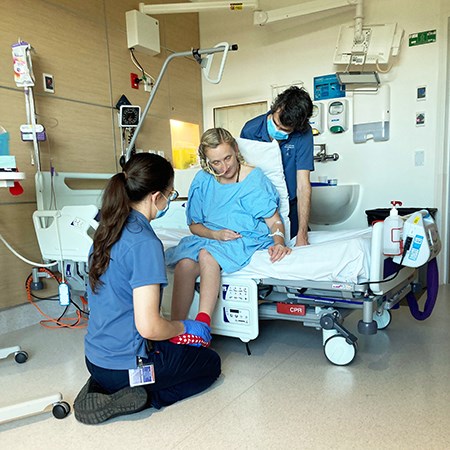
I slowly improved and when I was strong enough to breathe on my own, I was moved to the stroke ward. I was unable to talk, move my right side, or get out of bed. I would remain that way for a month.
I had daily physiotherapy in a bid to get me moving. They started with a tilt table then sitting up assisted. Initially, I could sit up for a few seconds after the physios let go before I’d slide sideways.
I was unable to eat so I had a feeding tube in my nose for the first two weeks or so. It was extremely irritating to the point where I kept pulling it out. As it turns out, getting one put back in is even more irritating and I would vomit every time.
I still couldn’t speak. I was diagnosed with aphasia and right-sided hemiplegia, which would later be downgraded to hemiparesis.
It was deemed I could try eating by week three. It was a success – I couldn’t feed myself, but I didn’t need the nasal tube anymore. It was a little win.
In week four, the conversation turned to where I would continue my rehabilitation. Jase was told I’d been given a place at Hampstead Rehabilitation Centre, where I would basically learn how to be a person again.
My future was still extremely unclear. Neurologists are very smart people, but every brain and every stroke is different, so they couldn’t offer Jase a definitive prognosis.
It was all about the recovery spectrum - ‘She might make a complete recovery (however unlikely!), or she might remain as she is right now’ kind of thing, which frustrated Jase no end.
I hadn’t said a word in a month, no one knew if I was ‘in there’ or not, but the day I was to be moved to Hampstead offered a big clue.
About six members of my neurology team had gathered around my bed to give me a final assessment and say goodbye.
Jase doesn’t know why he did it, but he asked me if I’d like to thank them for looking after me.
I don’t know what had changed, but I swallowed hard and rasped out ‘Thank you’.
The whole room went up and there were a few tears in the eyes of some pretty hardened medical professionals!
It wasn’t long before we received a pretty harsh reality check though.
I arrived at Hampstead on a bleak Friday afternoon and it was a lot for Jase to take in. As I was settled in by the nurses, he met a lot of new medical staff in a short period of time, and one of them was of the opinion that there was little hope for me and he should start looking at nursing homes.
I was laying there, now accustomed to people talking about me as if I wasn’t in the room, listening to every word.
The very next day, the physios got me out of bed using a sling lift into a wheelchair. On day two, they had me standing in a Sara Stedy – a rehab tool designed to encourage stroke patients to engage their leg muscles in a prelude to walking.
I also started speech therapy to learn how to talk again. I remember the first time I Facetimed Jason (with the help of my speech pathologist in navigating my phone) - he was blown away.
I worked on my handwriting in speech, had occupational therapy to focus on fine motor and life skills such as hanging out the washing, putting my hair up and making a cup of tea, and physiotherapy for physical things like standing, walking and exercising.
It was like I’d memory dumped everything I’d learned in my life.
My boys loved visiting me at Hampstead. They dubbed the physio rooms the “ball room” because of the amount of fitness balls and the basketball ring, the OT room the “games room”, and the courtyard the place where they searched for Hampstead’s elusive lizard.
They used to visit me on Fridays during the physio circuit class. Their presence would light up the faces of the other patients, most of whom were much older than me.
That room was where I learned how to walk again.
First, between the parallel bars so I wouldn’t fall over, with a physio having to physically move my right leg. It felt like it was a painfully slow process, but little gains were being made each day as they tried to ‘wake up’ my right side.
After a few weeks I was able to walk with the aid of a frame, then a walking stick – from where I’d been they kept saying it was nothing short of miraculous, but I was determined to keep improving.
My brain was finding new pathways (I learnt a lot about neuroplasticity!), which was great because large areas of my brain had suffered irreparable damage. The neurologist at Hampstead, a lovely man, once showed Jase scans with all the dark damaged areas of my brain.
He paused for a moment at one stage and said, “Jenny … I can’t explain her!”
I started having weekend leave to come home and spend time with my family. As we live in a two-story house with the bedrooms upstairs, I initially stayed in our guest bedroom on the ground floor.
After having to rely on daily FaceTime updates from Jason during my acute phase, my Dad, step-mother and brother were finally permitted to visit me. This reunion was tearfully wonderful.
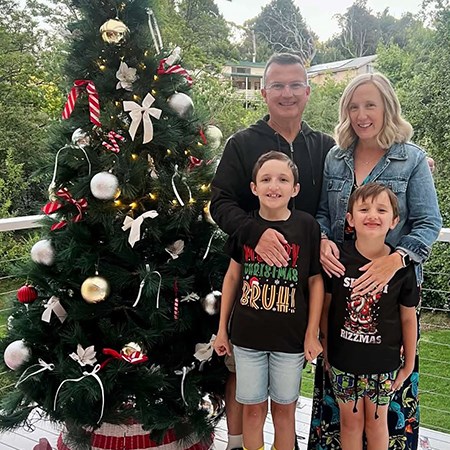
I was discharged on December 20 – five days before Christmas and the day before our wedding anniversary.
I walked out of Hampstead (with the aid of a walking stick) after three months, having been rebuilt as a person, determined to never take anything for granted again.
After a few months, I no longer needed my walking stick and only use it now when travelling or in a crowded place, more of a visual cue to others.
I attended Patrick’s first day of Reception and Darcy’s first day in the ELC. I also moved back upstairs to our bedroom, almost as soon as I came home.
I might have survived the stroke, but my AF continued to be an issue.
After experimenting with different cocktails of medications and riding the wave of side effects that came with them, my new cardiologist suggested I get a pacemaker.
He described it as a “set and forget” solution. I had some trepidation about undergoing two surgeries (one to insert the pacemaker, the other to “knock out” my AV node so the pacemaker would be in full control of my heart’s rhythm).
I had this done in late 2022, and haven’t looked back.
I had speech and occupational therapy until they both ‘broke up’ with me because there wasn’t anything left for them to do.
I sat my OT driving assessment and was flattened to fail, but I didn’t consider I hadn’t driven for nearly a year and my body had changed a lot since then.
I had driving lessons, was buoyed to learn that I didn’t need a modified car and passed the assessment nearly two years on from my stroke.
Armed with a newfound sense of freedom, I started volunteering at the boys’ school. This was in the canteen and the library initially. I also listened to Patrick and his Year One classmates read out loud, which was very rewarding.
I was also an active member of the school’s parents and friends’ association and was involved in many events and fundraising, which gave me more ways to exercise my life skills.
It was during this period that I gained an appreciation for the school’s Educational Support Officers (ESOs) and the work they did in supporting the teachers and students.
I was studying to be a teacher when I suffered my stroke and was still interested in a career in education. Volunteering at the boys’ school helped me realise I had a passion for being there when it all started – at primary level.
I enrolled in a Certificate III and IV in Education Support; the coursework was online with a placement component where I’d amass 100 hours of classroom experience.
I reached out to the Deputy Principal at the boys’ school. She knew my background and had been a wonderful support to Jason, Patrick and Darcy throughout our ordeal.
She was delighted for me to complete my placement at their school. I was placed in a Year 1 class, where I worked with a teacher who has since become one of my closest friends.
I passed all my assessments, graduated, and with fresh education support qualifications, started off by being an ESO relief equivalent; I was available to work any time they needed me, mainly in junior primary, but I was also called on to attend a Year 6 tree planting excursion.
While not only being rewarding in an environmental sense, it gave me the chance to put into practice physical skills that I’d worked on – even things like getting on and off a bus provided a new challenge, which I overcame.
At the end of the year, I was offered a year-long part-time contract, working every day from 8.15am to 1pm. I took it, and was delighted to learn I’d been placed in a Reception class.
I love my life now. The boys are thriving in Year 4 and Year 1 respectively, and love having me at school with them.
I work with a fabulous group of people and have a wonderful teacher this year. It’s a terrific place to be and I thoroughly enjoy being there.
I still have physio once a week; coincidentally, with one of the first physios I saw at Hampstead. We’re currently working on getting up off the floor because our class sits on the floor at assembly and I’d like to refine the action of doing that. She is amazed at how far I’ve come from the person she met when I first arrived at Hampstead.
I still have right-sided hemiparesis, which I’ll likely have for life. I also have apraxia, which is difficulty with planning movements even though I can physically do them. Basically, I understand what I want to do, but I sometimes have difficulty with the executive function of breaking tasks down into manageable components.
While my long and short term memory remain untouched, I still have hazy recollections of my entire acute phase.
I’m grateful to, first and foremost, my family for their unwavering love and support. When they say it’s just the person who suffers a stroke, it’s the whole family – they’re not wrong.
Jason was so stoic throughout it all. He had a critically unwell wife on life support and didn’t know IF I pulled through, what quality of life I’d have, and two young boys at home who didn’t know (blessedly) the full extent of what was going on. They all gave me something to fight for.
I’m grateful to the team of health professionals who ‘rebuilt’ me, notably my physio, who has been there from the start.
And finally, I’m grateful for the school community that supported our family throughout my recovery and gave me something to do, firstly with volunteering and now employment.
I know I’m lucky. This whole experience has taught me to never take anything for granted because you don’t know what’s around the corner.
If this story resonates with you and you have question, please call the team on StrokeLine 1800 787 653