Small steps forward
By Gus
As a double stroke survivor, I can tell you this: the overwhelming feeling is real.
In the early days, the road ahead felt impossibly big. The physical, mental, and emotional weight; the frustration, helplessness, fear, confusion, exhaustion, isolation, and loss of confidence, along with the many other mentally and physically debilitating challenges - all adds up.
After my strokes, the hardest part wasn’t just learning to recover, it was accepting what had happened, that I couldn’t stop it. I didn’t see it coming and then the realisation… this might be permanent; this could be the rest of my life.
Why me? Why now? What about all my plans, what about my future?”
One of the hardest truths is this; recovery isn’t linear and it isn’t the same for everyone. It wasn’t for me, and I often felt I had no clear way to measure progress, for me that uncertainty was one of the hardest things to accept.
You try hard, for a day, a week, a month, or even two or three and feel like nothing is changing. No progress. No wins. You won’t always see results straight away.
In hospital, two days after my first stroke (April 2014), I couldn’t hold a pen, no movement, no feeling ‘a dead hand’. I remember taping a pen to my hand so I could write a letter to myself, telling myself I would beat this, that I was a fighter, I was a warrior.
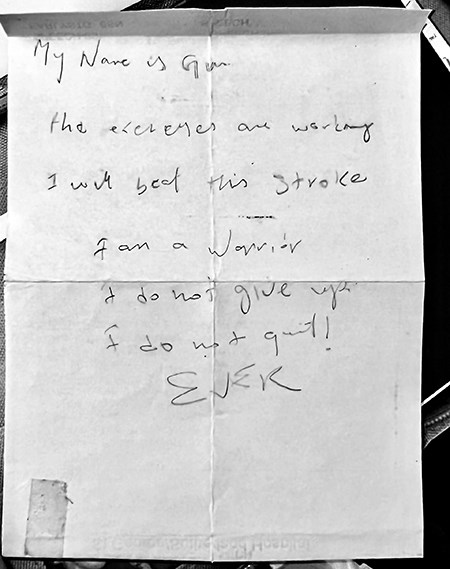
It says, “My Name is Gus the exercises are working I will beat this Stroke I am a warrior I do not give up' I do not quit! EVER!”
Writing it was slow, awkward, and every word took effort, but it mattered to me! Two months later, I wrote again. This time, no tape. It was not perfect, in fact, I could barely read some words, “Doctor’s handwriting,” I joked, but it was progress.
Over time, something shifts. I can’t tell you exactly when, but it does.
A bit more strength.
A movement that wasn’t there before.
A smile returning.
A step… then two, then three.
Words forming again. a sentence, a conversation, short, but none the less a conversation
Those moments matter. Because progress doesn’t come from one big breakthrough, it comes from consistency and showing up again and again, even when nothing seems to change.
Setting small, realistic goals helped me move forward. Some days, that meant simply getting out of bed and making it through the day. On those days, that was the win. And that counts.
Over time, those small steps build. One leads to another. Progress may feel slow, but it is still progress, those quiet achievements are the foundation of recovery.
I keep the letter I wrote then with me in my agenda to this date, to remind me how far I’ve come and how uncertain this journey can seem.
Stroke changes you. It changes how you see the world, how you measure progress, and how you move through life, but it is not the end. It’s a different path, one that challenges you, but also shows you how strong you can be. Just as important as moving forward is something we often forget, pausing. Rest is not failure, taking time is not giving up. In recovery, pausing is part of progress, It allows your body and mind to recover and gives you strength to continue.
And just as importantly, acknowledge yourself. Celebrate the effort. The small wins matter.
Speak to yourself with patience and kindness, because every step forward matters. Recovery isn’t about rushing, it’s about continuing, at your own pace, in your own way.
That, in itself is strength. That is grit. That is tenacity.
If you’re on this journey, you are not alone and every step matters.
It must matter to you, because it matters to your family, your loved ones and friends. It matters to me, because I know how hard it is… and I know you can do this.