Stroke, Recovery and Mateship
By Max and Ty
I was Ty’s PT and his mate before his stroke. He was four weeks out from a boxing fight. Training twice a day, most days. Fit, strong, and disciplined. Honestly, the fittest 50-year-old bloke I knew.
Then everything changed. Ty had a stroke; I got the call and couldn’t believe it. It didn’t make sense. This wasn’t someone you expected to have a stroke.
Ty:
“I went to Fortitude Boxing.
I had my stroke there.
It was an ischemic stroke.
I woke up a week later in Royal Brisbane Hospital.
I was very sick.
A week. That’s how serious it was.”
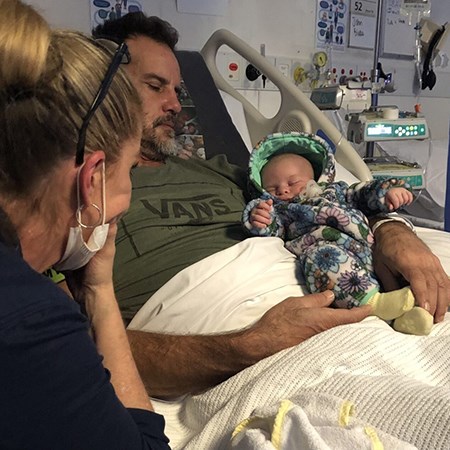
Ty’s stroke was massive. He wasn’t expected to survive. His wife Carla was told he wouldn’t walk again. That he would likely be fed through a tube. People looked at his brain scans and didn’t believe it was him.
Ty lost movement on his right side, his arm and his leg just didn’t work. He also developed aphasia, which meant he couldn’t say anything. For someone who had worked in sales and could talk to anyone, that loss of communication really hit him hard.
Ty:
“I was a sign writer and handyman.
I worked with my son Max.
I couldn’t do that anymore.”
That loss isn’t always obvious at first. It’s not just about the physical side of things. It’s identity, work, confidence, all of it.
Ty spent six months in hospital, doing speech therapy, OT and physio day after day. Carla was right there beside him the whole time, pushing him and supporting him every step of the way.
She showed up every single day, making sure nothing slipped through the cracks and that Ty kept going, even outside of formal therapy sessions.
He became a bit of a favourite at STARS. The staff really took to him, and everyone wanted to be part of his recovery.
Ty:
“I left STARS with a guard of honour.
I was very happy to go home.”
Getting home is where things really start to shift. In the hospital, you have support all around you. At home, it’s different. That’s when small, everyday things suddenly become big things.
Getting dressed can take time and patience. Getting up and down off the couch or the floor isn’t as simple as it used to be. Living without the use of your right-hand changes how you do almost everything, from making a cup of tea to tying your shoes.
These are the moments that really hit. The quiet, daily adjustments that no one sees. And they’re the things Ty had to come to terms with, one step at a time.
Ty:
“Not working was hard.
But I treated rehab as my job.
That mindset is everything.”
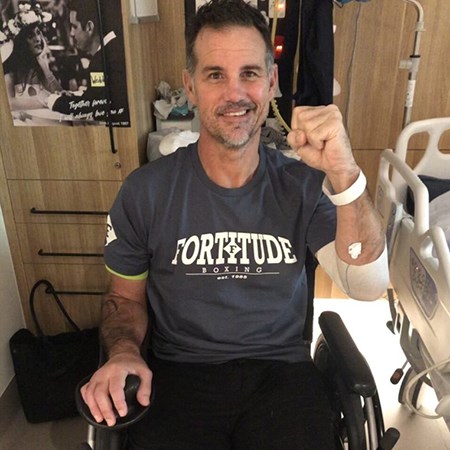
Ty’s mindset has been one of the biggest reasons he’s come so far. From the start, he just decided he was going to have a crack, no matter how hard it was. He shows up every day, even when he’s tired or frustrated, and puts the work in. But it hasn’t been just him. The support around him, especially Carla, and the team working with him, has helped keep that mindset strong. They’ve backed him, pushed him, and believed in him on the days he needed it most.
Ty:
“I slept two times a day.
It was very tiring.
Fatigue is real. And it sticks around.
Talking was another big one.”
Before his stroke, talking came naturally to Ty; he could connect with anyone, and conversations were easy.
After the stroke, that all changed. With aphasia, even simple conversations became challenging, and it took one to two years before he started to feel comfortable speaking to new people again. That loss of confidence doesn’t come back overnight. It takes time, patience, and a lot of effort.
But Ty never pulled away from it. He kept putting himself in situations where he had to try, even when it was frustrating or uncomfortable. He kept showing up, kept practicing, and kept having a go.
And now, he’s speaking at events, connecting with people again, and continuing to build that confidence step by step.
Ty:
“I go to gym.
Play pickleball.
Ride my trike.
Go for walks.
Practice my speech.”
He’s tried just about everything. All abilities cricket, fencing, touch football, and walking soccer. His therapists have all said the same thing. He’s the hardest working stroke survivor they’ve ever seen.
And it shows...
Ty:
“I’ve done Brisbane to Bay 50km ride three times.
Bridge to Brisbane three times.
Nationals all abilities touch football.
Spoke at a brain injury conference.
Nominated for Stroke Survivor of the Year.”
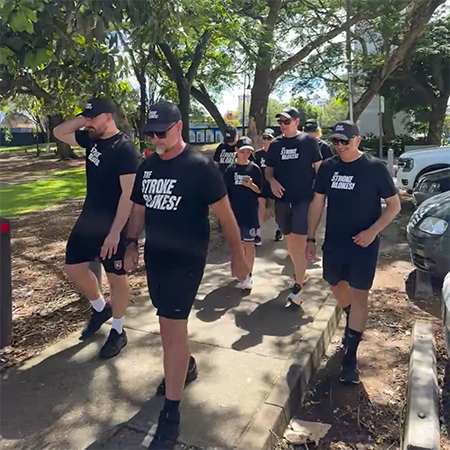
Now he’s training for the Paralympics, focusing on para cycling and swimming. That’s what showing up every day can lead to. Along the way, we also started something together, Stroke Blokes and Stroke Sistas. We catch up every few months, and it’s become a really important space. It’s about bringing people together, having somewhere you can connect with others who truly get it. Because the truth is, you can’t do this alone.
Ty:
“Maintain your family and friends network.
You can’t do it alone.”
Mates matter.”
I’ve worked with Ty pretty much full time for the past four years, and being alongside him has changed me more than I expected. I see every day how hard things can be for him. Simple tasks take more effort, and with aphasia on top of that, it’s a constant challenge. But even on the tough days, he doesn’t stop. He never asks for a break from it. He just keeps putting one foot in front of the other and getting on with it. Watching that up close shifts something in you. You stop making excuses. You start to see what’s actually possible when someone refuses to give in. It’s something I’ll carry with me for the rest of my life.
Ty’s top advice:
“Take one day at a time.
Laugh.
Have a good support team.”
And that’s probably the biggest takeaway from all of this.
It’s not just about recovery.
It’s about the people around you. The ones who show up. The ones who stick with you. The ones who push you and laugh with you along the way.
Because that’s what gets you through.