Using Technology to Change Stroke Recovery - Because I’ve Lived It
By Matthew
I’ve always loved computers. Programming, in particular, fascinated me from a young age. I studied computing at university and then went on to do a PhD, where I used computer modeling to study how cancer progresses. I was driven by one big question: how can technology help solve real-world problems?
I went on to have a mostly academic career at different universities. Then, in 2022, everything changed - I had a stroke.
That experience shifted my direction.
Since my stroke, I’ve felt a strong pull to give back - to use my technical skills in stroke research and stroke technology. But this time, my work is grounded not just in theory, but in lived experience. Mine, and other stroke survivors.
What the Future Leaders Grant Means to Me
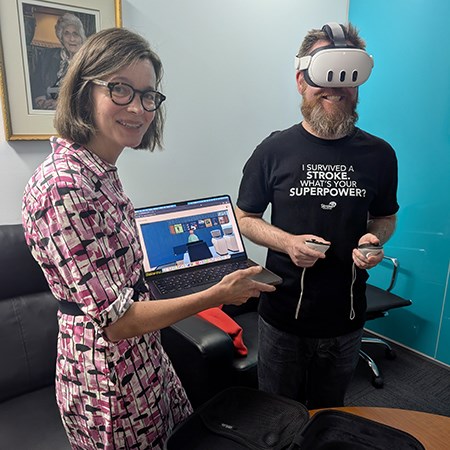
Matthew Berryman with Stroke Foundation CEO, Dr Lisa Murphy
When I found out I had received the Stroke Foundation Future Leaders Grant, it meant more than I can easily put into words.
My own rehabilitation journey motivated me to move into stroke research. This grant feels like recognition - not just of my work, but of the path I’ve walked to get here. It supports my research into how technology can improve life after stroke.
It has also helped me build connections and collaborate with others in the stroke research community. What matters deeply to me is that lived experience is being valued. Knowing that the Stroke Foundation recognises the importance of survivor voices in shaping research means just as much as the funding itself.
Building a Virtual World for Speech Practice
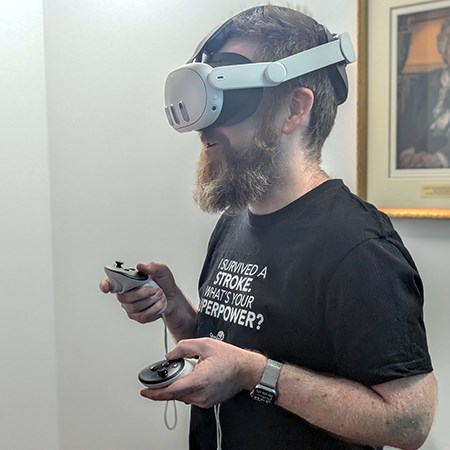
One of the projects I’m working on, an NHMRC Ideas Grant led by Professor Maria Kambanaros, uses virtual reality (VR) and artificial intelligence (AI) to help people with aphasia and other communication difficulties practice speaking. The work in the grant is to build a virtual ‘town square’, which will include places like a hairdresser and a grocery store. We’re also exploring ways for real people - other survivors of stroke or speech pathologists - to join the VR space for telehealth sessions.
The idea is simple: create realistic environments where people can practice everyday conversations safely and repeatedly - to improve speech and build confidence.
After a chat with Professor Maria Kambanaros, I was inspired to build a virtual café. In it, you can order coffee, speak to a salesperson, and chat with a barista - just like in real life.
I use it myself to practice speaking slowly and clearly, using the techniques my speech therapists have taught me. Recently, when I ordered coffee in a real café, I noticed something had changed. I felt more confident. More fluent. More at ease.
That moment meant a lot. It’s exciting, but it’s also deeply personal.
Exploring AI and Aphasia
Alongside the VR work, I’m also researching how people with aphasia are using, or could use - artificial intelligence to meet their own goals.
The Stroke Foundation grant has supported important conversations with researchers, software developers, and people with lived experience here in Australia and around the world. These discussions are shaping how this technology can truly serve the people it’s meant to help.
Technology should adapt to us - not the other way around.
Making Rehab More Inclusive
I also volunteer on the rehabilitation ward where I was once a patient. Being back there in a different role has been powerful.
One thing that stands out to me is how vulnerable stroke survivors from culturally and linguistically diverse backgrounds can be. Language barriers and a lack of culturally appropriate resources can make it much harder to understand care, take part in therapy, and plan for life after discharge.
Recovery is already challenging. It shouldn’t be made harder by language or cultural barriers.
Dina Pogrebnoy and her team at Western Health conducted research into what self-directed resources patients prefer during inpatient rehabilitation. They created a video library showing stroke survivors from diverse backgrounds completing rehabilitation activities.
With support from a Stroke Foundation seed grant, those videos are now being translated into Vietnamese, Mandarin, Cantonese and Arabic.
Although I’m not from a culturally diverse background myself, I know I would have benefited from video resources during my own inpatient stay. I learn best by watching. Many people do.
Creating Something That Doesn’t Yet Exist
To make these videos truly accessible, they need to live on a platform that works for survivors in hospital.
As far as we know, there isn’t currently a digital app specifically designed with, and for survivors of stroke in inpatient rehabilitation.
So, Dina asked me to work with her to create one.
We’re now co-designing a tablet app with stroke survivors and clinicians at Western Health. We’re asking them what they actually need. What would make this useful? Simple? Accessible?
Once we understand that, I will build a custom, multilingual app. It will allow clinicians to prescribe relevant activities and help stroke survivors use the video content to stay active and engaged in their recovery.
Having a stroke changed my life. But it also gave my work a new direction and purpose.
I still love technology. Now, I’m using it to help solve a problem I understand from the inside.
And that makes all the difference.