The TakeAway: Hailey talks about mental health, anxiety and fatigue after a stroke
I had a stroke when I was six years old, more than 25 years ago now. It took a long time to get a diagnosis, and during that whole time, I felt so confused and scared.
I remember having these overwhelming feelings I couldn’t even put into words. I was really terrified. I was a little kid dealing with aphasia, constant fatigue, and balance issues. It was beyond my understanding.
For a while, I felt ashamed of what had happened. I became really frustrated and annoyed with myself.
Hi Hailey, what do you want people to know about you? (0.15 sec)
“I am 32, a big lover of coffee. Art, poetry, and heavy metal music. My favourite bands are Slipknot and Escape the Faith.”
You have lived experience of dealing with mental health challenges after a stroke, and you also worked for a youth mental health service. (0.38 sec)
“I worked with young adults with acquired brain injuries and mental health challenges for 10 years. I now work for Stroke Foundation.”
Resources:
Can you describe how stroke affected your mental health in the early days? (1.02 mins)
For me, being a childhood stroke survivor, it was hard for me to wrap my head around what stroke was and it was a very scary time for me....I felt very alone and that definitely contributed to the mental health challenges that I faced.”
Resources:
- Childhood stroke resources
- StrokeLine (1800 787 653)
- Mental health after stroke (Video)
- Lifeline (13 11 14)
- BeyondBlue
How has your experience managing your emotions or even your fatigue changed over time? (1.53 sec)
“Post stroke I couldn’t comprehend much because it was all so big and scary, but over time I have learned how important it is to be able to articulate what you’re experiencing and being able to communicate to people around you what you need and what your experience has been.”
Resources:
- Being your own champion (Young Stroke website)
- Getting the help that you need (blog)
- Managing fatigue (EnableMe)
- Emotional changes after stroke (Young Stroke website)
How do you manage your anxiety? (3.09)
“For me personally, my anxiety is really easy to see. I have tell-tail signs that give it away. I have hemiplegia so my right arm becomes quite rigid and stiff and gets a mind of its own......”
“I know I need 5-10 minutes by myself in a room to put in place my coping strategies like mediation or taking 5 minutes to recenter myself.”
Resources:
- A Mindful Approach to Reclaiming Your Identity (American Stroke Association)
- Meditation to Boost Health and Well-Being (American Heart Association)
- Being present – focusing on the NOW a blog by Emma Gee
- David Roland explores the role of nature in his recovery journey (Young Stroke website)
Do you talk to yourself? (4 mins)
“Yes! I have mantras that I say to myself quite often. I think a positive inner voice - that definitely plays a big role in managing mental health.”
How do you develop a positive inner voice? It’s easy to say, but harder to do. (4.17 mins)
“For me personally, it came from a lived experience. For a good chunk of time after school I was dealing with some very heavy mental health issues, and I learned that having a negative inner voice paints the way you see yourself in your won head....”
Resources:
- Improving self confidence
- Post trauma growth (Young Stroke website)
Do you have tools, resources, or people that you speak to? (5.16 mins)
“Feeling isolated plays into my mental health. So, I have people I speak to, and I think that stroke support groups are really important for that.... As well as the person who will be your cheerleader, and for me it’s my husband and stepson....”
What emotions did you find most challenging to cope with after your stroke? (5.46 mins)
“It was noticing the difference between me and my peers. Not being able to do what I used to. Like I used to have the energy to run for hours on end, but after my stroke fatigue hit really hard.”
“Not being able to emotionally process a lot of it made it trickier to navigate...”
Resources:
- Living with fatigue (Young Stroke website)
- Personality changes after stroke (EnableMe)
- Thinking and perception after stroke (EnableMe)
Do you think that there is a relationship between trying to manage your emotions and fatigue? (6.28 mins)
“For sure! I know for me I couldn’t articulate my fatigue until I had to explain it to my husband.... I think that being able to articulate what it means makes it easier to ask for what you need.”
How do you explain fatigue? (7.09 mins)
“For me there are different categories of fatigue; emotional fatigue, physical fatigue, mental fatigue and sensory fatigue.
My husband and I have had many conversations about what fatigue I am experiencing.... putting language to how you are feeling is really important.”
When I am experiencing mental fatigue, I also have aphasia....”
Resources:
- Sensory changes after stroke (EnableMe)
- The TakeAway: Talking about fatigue with Toni Arfaras
- Aphasia and communication changes after stroke (Young Stroke website)
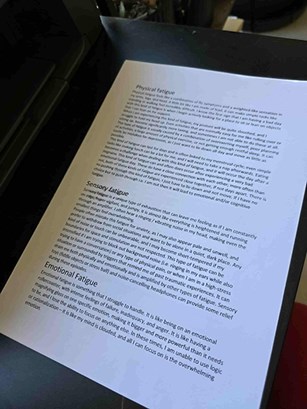
You mentioned a book that you write in for your husband at the end of the day to explain how you are feeling. Can you tell us more about that? (8.36 mins)
“Yes, when I feel really physically fatigued, I really struggle with communication. Getting a sentence out is like writing a three-thousand-word essay for me. But if I bring out the book and hand it to him, it tells him I am feeling this way and I need quiet, and less stimulation - which gives him the cues as what to do.”
What role does connection with other people or support groups play in your mental well-being? (9.39 mins)
“I didn’t meet another stroke survivor for three years, and meeting people who have experienced what you have to me is the most important thing. It does what therapy can’t in regard to making you feel normal, seen and heard, and not alone in the world.
It’s one of the most important things that you can do.”
Do online support networks and face-to-face networks both work well for people? (10.26 mins)
“Being involved in a support network in any capacity that you’re okay with. Initially for me it felt really overwhelming and mu mental health and anxiety was not in a place to be with other people. An online support group or an online coffee club is a really non-confrontational way of joining a support group.”
Resources:
- Find a local stroke support group (Enableme)
- Find an online stroke support group (Young Stroke website)
- Find a local stroke support group - aphasia (EnableMe)
- Find a local carers or family support group (EnableMe)
You worked in mental health; how has this influenced your own recovery? (11.24 mins)
“It gave me the knowledge that I was not alone in what I was feeling. Working within the field, one of the most important things I have learned is that just because something works for you, that doesn't mean it will work for everyone. It’s really important to meet people where they are.”
Are there any misconceptions about stroke and mental health that you wish people understood better? (12.32 mins)
“I feel like at the end of the day that even though I had my stroke 26 years ago it’s still something that affects me in my day-to-day life. It’s not something that you get over; it’s not like the flu.”
“Mental health is something that you constantly need to be vigilant about and maintain.”
“In regard to people saying that you should be over that by now it is a really dangerous attitude to have towards survivors because it stops them feeling like they can talk openly about their mental health...”
So, if somebody has said that to you, can you tell me how that would make you feel? (13.37 mins)
“Sometimes it can be quite uplifting, but sometimes it can be invalidating as well. Just because you’ve made it through worse, doesn’t mean this is any less difficult.”
Resources:
Do your fur-babies (dogs) help with your mental health? (14.15 mins)
“For sure!”
Resources:
- The role of animals in stroke recovery (Stroke Association UK)
We talked about Slipknot being one of your favourite bands. Is there a song that you listen to that helps with your mental health? (14.28 mins)
“I do have a lot of social anxiety about being out in public, and I am asked questions about my hemiplegia and what happened. It causes quite a high level of anxiety in me because my experiences were traumatic.
There is a song by Slipknot called ‘Before I Forget’ and it ‘gees’ me up into thinking I can take on the world...”
More in the TakeAway series:
- The TakeAway: talking about fatigue with Toni Arfaras
- The TakeAway: talking about mental health after stroke with Clive Kempson
- The TakeAway: talking about how equine-assisted social workers can help in stroke recovery with Barbara Wolfenden
- The TakeAway: talking about movement and exercise with Emma Gee
- The TakeAway: talking about goal setting with Tommy Quick
- The TakeAway: Shannon shares her experience with aphasia and apraxia
- The TakeAway: Joel talks about mindset and exercise after stroke
- The TakeAway: Brooke shares her experience with accessible travel
- The TakeAway: Heidi talks about managing pain after stroke
- The TakeAway: Nicole talks about parenting after a stroke