The TakeAway: Talking with Prof Vincent Thijs about the SEARCH research project
Professor Vincent Thijs is a leading stroke specialist with more than 20 years of experience. He is passionate about improving stroke treatment, especially for younger people, and leads major research projects in Australia and around the world. Vincent also heads Neurology at Austin Health and mentors the next generation of stroke researchers.
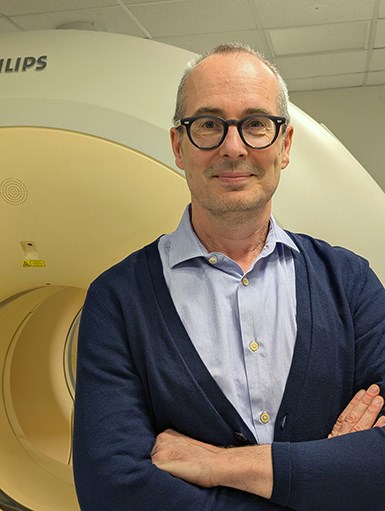
We're here today at the Austin Hospital to talk to Prof Vincent Thijs about the SEARCH research project.
Vincent is leading an important research project focused on a specific type of brain bleed. He explains that while many people know about high blood pressure causing hemorrhagic stroke, there is another common cause called cerebral amyloid angiopathy (CAA).
“There are ischaemic strokes and there are haemorrhagic strokes… in a haemorrhagic stroke a blood vessel ruptures in the brain and causes damage.”
He explains that CAA happens when a protein called amyloid builds up in the blood vessels of the brain, making them fragile. Traditionally, doctors could only see this amyloid “when they take parts of the brain and put it under the microscope”, which is not functional while someone is alive.
Vincent’s research is working to change that.
“Our study is investigating a new technique to detect amyloid while people are still alive – even before a stroke occurs.”
The goal is earlier detection, better understanding, and ultimately better prevention of these types of brain bleeds.
How rare is cerebral amyloid angiopathy (CAA)?
The SEARCH team are drawing attention to a lesser-known cause of brain bleeds in younger people: cerebral amyloid angiopathy (CAA). While CAA is well-known in older adults, especially those over 85, it is “relatively rare in people under 60,” which means it is often overlooked.
Vincent explains that CAA is actually “the second most common cause of brain bleeding in older people, if not the most frequent,” but in younger people it is not usually considered. This can leave younger stroke survivors without clear answers.
A key concern is that “if you have a stroke at a young age, it’s particularly devastating,” and when that stroke is a brain bleed, doctors often cannot identify the cause. CAA could be one of those hidden causes.
Because CAA is hard to diagnose with current tools, the SEARCH team are working with support from Stroke Foundation to study it more closely. Their goal is to change how young-onset brain bleeds are understood and diagnosed.
“Most of the time we don’t know what causes the brain bleed, and amyloid could be a potential cause… that’s why we’re investigating this in a systematic way.”
Vincent and the SEARCH team are exploring a new brain imaging technique that can detect signs of cerebral amyloid angiopathy (CAA) and give people clearer answers after a brain bleed. This new approach may help survivors understand why their bleed happened, whether they are at risk of another one, and what to expect next.
Currently, people often go through multiple scans - MRI, CT, vessel imaging, and repeated follow ups – which can be costly, exhausting, and still lead to uncertainty. This new technique has the potential to streamline that journey and finally provide clarity where traditional scans cannot.
Key Quotes from Vincent
- “This technique may help people better understand their diagnosis and why they may have had a brain bleed.”
- “We try to make this as efficient as possible because many brain scans are expensive, difficult, and often there is not even an answer.”
- “This technique may provide a new answer, and that is wonderful after going through all of these diagnostic moments and still coming out without one.”
What led you to investigate CAA?
Vincent is driven by curiosity and a commitment to solving unanswered questions about complex neurological conditions. With a background in brain imaging, he focuses on developing and applying innovative techniques to better understand what’s happening inside the brain - especially in living patients. His work aims to uncover new insights that can ultimately improve diagnosis, treatment, and support for people affected by brain-related diseases.
Key Quotes from Vincent:
- “As a researcher, you're always looking for what is novel and what is unanswered - the mysteries of a condition, the mysteries of a disease.”
- “I’ve always been drawn to novel techniques to investigate and have a look inside the brain, especially while people are still alive.”
The SEARCH project began in 2019, please tell us more about it.
The team's research uses a PET scan technique to detect amyloids in the brain, which is different from a standard MRI. By tagging amyloid with a radioactive tracer, the scan can show where the amyloid molecules are binding, providing a clear visual image. Unlike MRI, this method involves injecting the tracer and highlights areas that might otherwise be invisible on traditional imaging.
What are some of the challenges that the SEARCH team has faced?
The research team is looking for more participants to help complete their study on brain bleeds, aiming for 140 participants and currently at about 85. They are seeking adults under 70 who have had a brain bleed, regardless of the suspected cause, to better understand different contributing factors.
Is there any feedback from participants or the research team that can be shared?
Participating in research gives people the chance to contribute to understanding a devastating condition that currently has few treatment options. The SEARCH study aims to improve early diagnosis of amyloid angiopathy, which could lead to better treatments in the future. Early detection is key, and ongoing research and clinical trials are crucial to tackling this disease.
Key Quotes from Vincent:
- “People are often very thankful that they get an opportunity to contribute to research by being a participant.”
- “The sooner you detect [amyloid angiopathy], the better it will be able to be treated.”
- “It’s vital now that there are research being offered, clinical trials being done, novel molecules being detected to hold the disease process.”
Vincent champions the involvement of people with lived experience in research. How is this supported in the search project?
The study was designed with lived-experience input to make sure the schedule isn’t too demanding, and the information provided is easy to understand. Participation involves reading a consent document, completing some assessments via telehealth, and attending a scanning session that takes about 90 minutes. Participants can also choose to give a blood sample - and in some cases a DNA sample - to help researchers explore whether amyloid can be detected through blood or genetics.
Key Quotes from Vincent:
- “We made sure the schedule and materials were accessible for our participants.”
- “It’s a little involved but not too heavily - about 90 minutes for the scan plus optional blood and DNA samples.”
What are the most rewarding aspects of your role?
The most meaningful part of this project is being able to support people during an incredibly difficult moment - helping them understand whether they truly have this condition and giving them clearer answers. Beyond that, the opportunity to influence clinical practice and improve how stroke is diagnosed and managed is a powerful driver for the team.
Key Quotes from Vincent:
- “Being able to improve how we treat and diagnose people is what drives me.”
- “The most rewarding aspect of this particular project is to be able to offer somebody who has received a terrible diagnosis and help clarify whether they have it or don’t have it.”
- “You can provide help immediately and then as a researcher also build up that knowledge that will help future generations.”
- “We have a very good team of neurologists and study coordinators that help us through the journey.”
Is your ability to help people what motivates you?
Key Quotes from Vincent:
- “Being a doctor means I can help people immediately, while being a researcher means building knowledge that will help future generations.”
- “As a researcher, every discovery contributes to the treatments of the next decade - it’s a way of building a legacy.”
- “One of the great advantages of this work is being able to make an impact now and also shape what stroke care will look like in the future.”
What is your message to supporters and research participants?
- “If you can help researchers do their job and come up with new ideas, new treatments, that's very gratifying.”
- “You as a research supporter are helping to create that novel science, that novel treatment, being a little part of the whole wheel that is science.”
- “That is actually vital.”
A heartfelt thank you to the Bennier family from the SEARCH project team, “We are extremely thankful to the Bennier family and supporters: this research would not have been possible without the generous support of the Memorial Fund. Worldwide, there is a lack of funding for stroke research in comparison to other conditions. Even less money is available for intracerebral hemorrhage due to amyloid angiopathy. We think that our project will provide valuable insights into this poorly recognised devastating condition. We are extremely grateful for the support we receive from the Gavin Paul Bennier Memorial Research Fund. Without this support, this world's first project would not have been possible.
We are extremely grateful for the Gavin Paul Bennier Fund’s continued support in this challenging project. The study is gaining momentum and will hopefully provide hemorrhagic stroke survivors with an accurate and timely diagnosis. With treatment options at the horizon, this work, supported by the fund, will gain further significance.”